|
Poetry is a powerful creative tool that humans have been using for adaptation since we could speak. There is neurological evidence of a response to poetry in pre-literate children and archeological evidence of a long tradition of the use of oral poetry in pre-literate civilizations. Poetry activates memory, insight, and emotions in the writer and reader/listener, helping create a sense of interconnectedness and also facilitates learning. The human brain may, in fact, be hard wired for poetry.
The importance of language and nonverbal expression, with special emphasis on metaphor, surprise, repetition, tone, resonance, and both direct and indirect communication, overlaps with clinical hypnosis. Thus, poetry, like clinical hypnosis, facilitates information processing through both conscious and subconscious systems. “The unconscious mind writes poetry if it’s left alone.” Stephen King There is a growing body of research supporting expressive writing in general and poetry specifically as a tool for psychological wellness. For example, research on expressive writing found that individuals who wrote about traumatic experiences for 20 minutes a day for four consecutive days experienced fewer symptoms of depression and anxiety six months later than those who did not engage in expressive writing. Similarly, a review of studies published in the Journal of Poetry Therapy found that poetry therapy can be effective in reducing symptoms of depression, anxiety, and trauma and in improving overall well-being and quality of life. There is a simple poetry exercise I have used with clients in supporting both increased awareness of feelings and experiences and fascilitating integration. It is called the concrete feeling exercise. I explain that feeling words are abstract…sad, angry, overwhelmed. These words just don't cut it when trying to explain how we are feeling. The concrete feeling activity can help turn abstract feeling words into concrete imagery. Here's how it goes: 1. Write an abstract feeling word on a piece of paper, such as depression or trauma. Circle the word and then draw lines out from the circle. 2. Write other words next to the lines that help you see what the feeling might look like. Words that make the feeling more concrete and felt with the senses. For example, you can explore: if it was a color, a shape, an animal, a place, a texture, a taste, an object…what would it be? 3. Finally, write a free verse poem using these words. The goal is to write a poem that helps us see the feeling word in a concrete, sensory way. This exercise was used with a client of mine who suffered the loss of her fiance to a sudden death ten years ago. She was still dealing with the loss such that she could not commit to a new relationship despite being with her current partner for over two years. The poem we co-created from her words shifted her experience. Read the poem and see if you can tell why it was so impactful. The sky blue grey raining tears of broken glass pieces of my heart left at the chapter's end and the excruciating privilege to be human and alive to have known love and feel deeply the beautiful bittersweet moments like dark chocolate that I will return to again and again Try this for yourself and see what you thhink. Some references: Niles AN, Haltom KE, Mulvenna CM, Lieberman MD, Stanton AL. (2014). Randomized controlled trial of expressive writing for psychological and physical health: the moderating role of emotional expressivity. Anxiety Stress Coping. 27(1):1–17. Mazza, N. (2017a). The evolutions of poetic inquiry, practice, education, and evaluation in poetry therapy. Journal of Poetry Therapy, 30(1), 1–2 Mazza, N., & Hayton, C. J. (2013). Poetry therapy: An investigation of a multidimensional clinical model. The Arts in Psychotherapy, 40(1), 53–60. For further references, check out my book CORE Hypnosis: A Compassion Informed Therapy, in which I dedicate a whole section to the use of poetry for healing.
0 Comments
Dear Community,
I am thrilled to share some exciting news with all of you! Recently, I had the honor of participating in the Valentine's day poetry contest of the on-line journal What Is Love To You, and I am absolutely delighted to announce that my work has been awarded 2nd place. I am deeply grateful to the judges for recognizing my piece, A Word So Concealed, among the entries. Winning this award has further fueled my commitment to exploring the depths of poetry and sharing my voice with the world. As I continue to grow and evolve as a writer, I look forward to sharing more of my work and experiences with all of you. Once again, thank you from the bottom of my heart for being a part of this journey with me. Your encouragement means more to me than words can express. With gratitude, Harilaos Stefanakis --- Click here to read the poem:  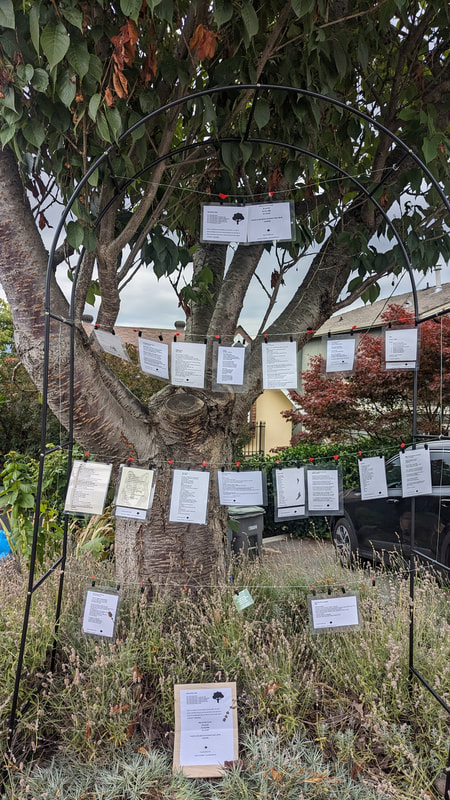 While in San Diego speaking at a conference on the use of of poetry in the treatment of trauma, a friend of mine who lives in South Park took me to the Poet Tree that was coincidently only a few blocks from the airbnb I rented for my stay. The creators of this Poet Tree placed poems on there that those passing by can read and even take with them. This was such a wonderful and compelling idea that I decided to create one in Vancouver and have done so. The only difference is that in my Poetry Tree, I also invite others to share their poems whenever they wish. in addition to offering a variety of poems for the taking. My hope is that this becomes an opportunity for community engagement and an antidote to the fragmentation of society that I see all around me. I have already had some positive interactions. Given the wetter and windier weather in Vancouver as we head into fall, I had to laminate and double clip the poems… but so far so good. I hope to expand this project a little more simply by pinning poems to trees throughout the city. If you would like to contribute a poem to the poetry tree send it to me or tell me which one and I will add it. My only criteria is that, at least for now, the poems focus on themes that are uplifting, inspiring, tranformative, and/or challenge one’s fragmented mindset. Perhaps some of you will be inspired to start poetry trees in your own communities as well. HistoryI searched the web for poetry trees or poet trees and found two key references that may indicate an older and more modern take on this idea. History From wikipedia I found The Poem Tree was a beech tree with a poem carved into it by Joseph Tubb in the 1840s, located on Castle Hill at Wittenham Clumps in Oxfordshire, England. In more modern times, 2011 to be exact a A. E. Housman‘s poem: LOVELIEST OF TREES was pinned to a Cherry tree in a university Campus by a student who then recreated the idea as an activity for poetry month. Others have also created poetry trees of various sorts in community based exercises that often involve writing poems on paper cut out as leafs and then placed together as a community project. It is late in the world the heroes have all been tamed my knife is dull, no blood to give but do not listen to me My tears look for clouds to carry them forth drowning the earth but do not listen to me You are the whet stone and the blade to cleave truth from the stars will we listen to you He holds my hand below the drought his voice is multitudes The day has come raise us before the years make dull the stones can you hear us You were the guides we are the journey trees grow in our tracks can you hear us We offer feathers for your minds to fly beyond fear and greed can you hear us I let go, and where they walk, a forest rises are you listening |